
October 2, 2026
Heat Pump vs Furnace: Which Is Right for a North Carolina Winter
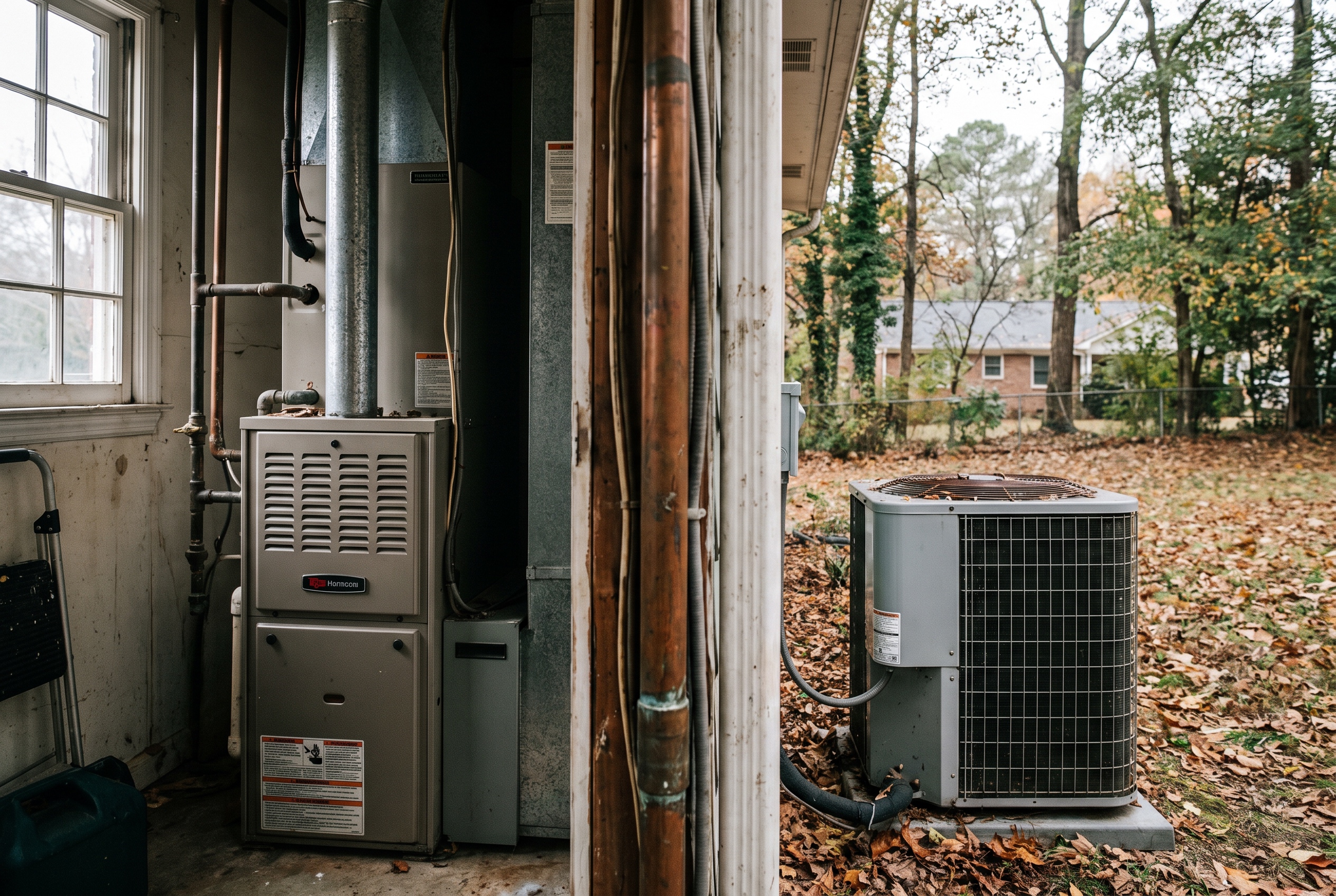
Should I Have a Heat Pump or a Furnace?
This question comes up constantly once fall sets in, usually from someone whose furnace just died or whose old system is clearly on its way out. Heat pump vs furnace isn’t a question with one universal right answer, but it’s also not as complicated as a lot of sales pitches make it sound. The right choice depends mostly on your specific home, your existing setup, and how you think about upfront cost versus long-term operating cost. Here’s how we actually walk homeowners through it.
How Each System Actually Works
A gas furnace generates heat by burning fuel, usually natural gas or propane, and distributes that heat through your ductwork using a blower fan. It’s a combustion-based system, which means it produces heat directly rather than moving it from somewhere else. Furnaces are capable of very high output and can heat a home quickly even in extreme cold, since they’re not dependent on outdoor conditions the way a heat pump is.
A heat pump works completely differently. Instead of generating heat, it moves heat. In heating mode, it extracts heat energy from the outdoor air, even when it’s cold outside, and transfers that heat indoors. It’s essentially the same technology as your air conditioner running in reverse, which is why a heat pump also handles your home’s cooling, something a furnace can’t do on its own. Because it’s moving heat rather than creating it through combustion, a heat pump is inherently more energy efficient under most conditions.
Why North Carolina’s Climate Actually Favors Heat Pumps
This is the part that surprises people who assume heat pumps are only for mild climates. North Carolina’s winters, while they do get genuinely cold for stretches, spend most of the heating season in a temperature range where modern heat pumps perform extremely well. Heat pump efficiency declines as outdoor temperatures drop, but current cold-climate heat pump models maintain solid performance well into the 20s and even lower depending on the equipment.
The Triangle typically sees its coldest stretches in January and occasionally into February, with overnight lows in the 20s and the rare dip into the teens. For the bulk of the season, which runs from roughly November through March with plenty of 40s-and-50s days mixed in, a heat pump operates efficiently and comfortably. It’s really only during the coldest weeks of the year that the equation shifts, and that’s exactly why dual-fuel systems exist for homeowners who want the best of both approaches.
The Cost Comparison, Honestly
Upfront installation cost tends to favor furnaces slightly, particularly if you’re replacing an existing furnace in a home that already has gas service run to it. A straightforward furnace replacement is often less expensive to install than a comparable heat pump system, especially if any electrical upgrades are needed to support the heat pump’s power requirements.
Operating cost is where the picture gets more interesting, and it depends heavily on your local utility rates for electricity versus gas. In general, a heat pump operating in mild to moderate cold, which describes most of a Triangle winter, costs less to run than a gas furnace because it’s moving heat rather than generating it through combustion. During the coldest snaps, when a heat pump’s efficiency drops and it may need backup heat to keep up, the cost advantage narrows or can even reverse temporarily. Over a full winter, most Triangle homeowners find heat pumps come out ahead or roughly even on operating cost, but it’s worth running actual numbers based on your specific utility rates rather than assuming either direction.
There’s also the cooling side of the equation that often gets left out of this comparison. If you need to replace your AC anyway, a heat pump replaces both your heating and cooling systems with one piece of equipment, which can mean lower combined installation cost compared to buying a furnace and a separate AC system.
Where a Dual-Fuel System Makes Sense
A dual-fuel, or hybrid, system pairs a heat pump with a gas furnace as backup. The heat pump handles heating under normal conditions, when it’s operating efficiently, and the system automatically switches over to the gas furnace during the coldest stretches when a heat pump alone would need to lean heavily on less efficient backup electric resistance heat.
This setup genuinely gives you the best of both systems: heat pump efficiency for the majority of the season and furnace reliability and output during genuine cold snaps. It costs more upfront than either system alone since you’re installing both pieces of equipment, but for homeowners who already have gas service and want to maximize efficiency without sacrificing performance on the coldest days of the year, it’s often the smartest long-term choice. Our heating services page covers more on dual-fuel setups if that’s a direction you want to explore.
What Pushes the Decision One Way or the Other
A few specific situations tend to make the choice clearer than a general comparison can:
If you don’t currently have gas service to your home, installing a furnace means either running a new gas line, which can be a significant expense depending on your home’s location relative to existing infrastructure, or going with a propane tank system. In that situation, a heat pump is very often the more practical and cost-effective path since it only requires electrical service you likely already have.
If your home already has both a furnace and central AC that are both aging out around the same time, replacing both with a single heat pump system is worth seriously considering, since you’re consolidating two replacements into one system rather than buying two separate pieces of equipment.
If you’re especially sensitive to utility costs during extreme cold snaps and want maximum reliability regardless of outdoor temperature, a furnace, or a dual-fuel setup with furnace backup, gives you that certainty. A furnace doesn’t lose capacity as it gets colder outside the way a heat pump does.
If a specific room or addition in your home has always been hard to heat and cool evenly, a ductless mini split, which is itself a type of heat pump, might be a better fit than extending either a furnace or a central heat pump system into that space. Our mini split page covers that option if it’s relevant to your situation.
Our Honest Take
For most Triangle homes replacing an aging system today, a heat pump is a strong default choice given our climate, and it has the added benefit of handling both heating and cooling with one system. If you already have gas service and want the extra peace of mind for the coldest weeks of winter, a dual-fuel setup is worth the additional upfront cost for a lot of households. A furnace-only system still makes sense in specific situations, particularly where gas service already exists, budget is the primary constraint, and the home already has a separate AC system with plenty of life left in it.
There isn’t a single right answer that applies to every home, which is exactly why this is worth a real conversation rather than a generic recommendation. We’ll walk through your specific situation, your existing equipment, your utility setup, and your budget, and give you a straightforward answer rather than steering you toward whichever system happens to be more profitable for us. Get in touch here to talk through what makes sense for your home, or check out our heating services page for more detail on both options.
Frequently Asked Questions
Do heat pumps actually work in cold weather?
Yes, modern heat pumps perform well in temperatures well below freezing, and cold-climate models are specifically designed to maintain efficiency into the 20s and lower. Efficiency does decline as temperatures drop, which is why some homeowners pair a heat pump with furnace backup for the coldest weeks of the year, but for the majority of a North Carolina winter, a heat pump alone handles the job efficiently.
Is a heat pump cheaper to run than a gas furnace?
In mild to moderate cold, which covers most of a Triangle winter, heat pumps typically cost less to operate than gas furnaces because they move heat rather than generate it through combustion. During the coldest stretches of winter, the cost advantage narrows and can shift depending on your specific electricity and gas rates. Running the numbers based on your actual utility costs gives a more precise answer than a general rule.
What is a dual-fuel heating system?
A dual-fuel, or hybrid, system pairs a heat pump with a gas furnace. The heat pump handles heating during normal conditions when it’s operating efficiently, and the system automatically switches to the gas furnace during the coldest weather when furnace output is more efficient than a heat pump’s backup heat. It combines the efficiency benefits of a heat pump with the reliability and output of a furnace during extreme cold.
Can a heat pump replace both my furnace and my air conditioner?
Yes. A heat pump handles both heating and cooling with a single system, since it’s essentially the same technology as an air conditioner that can also run in reverse to provide heat. For homeowners whose furnace and AC are both aging out around the same time, replacing both with one heat pump system is often more cost-effective than replacing them separately.
Categories

Let's Talk.
We’ll be happy to get you the pricing, service or information you need as soon as possible.