July 17, 2026
How to Improve Indoor Air Quality During Wildfire Smoke
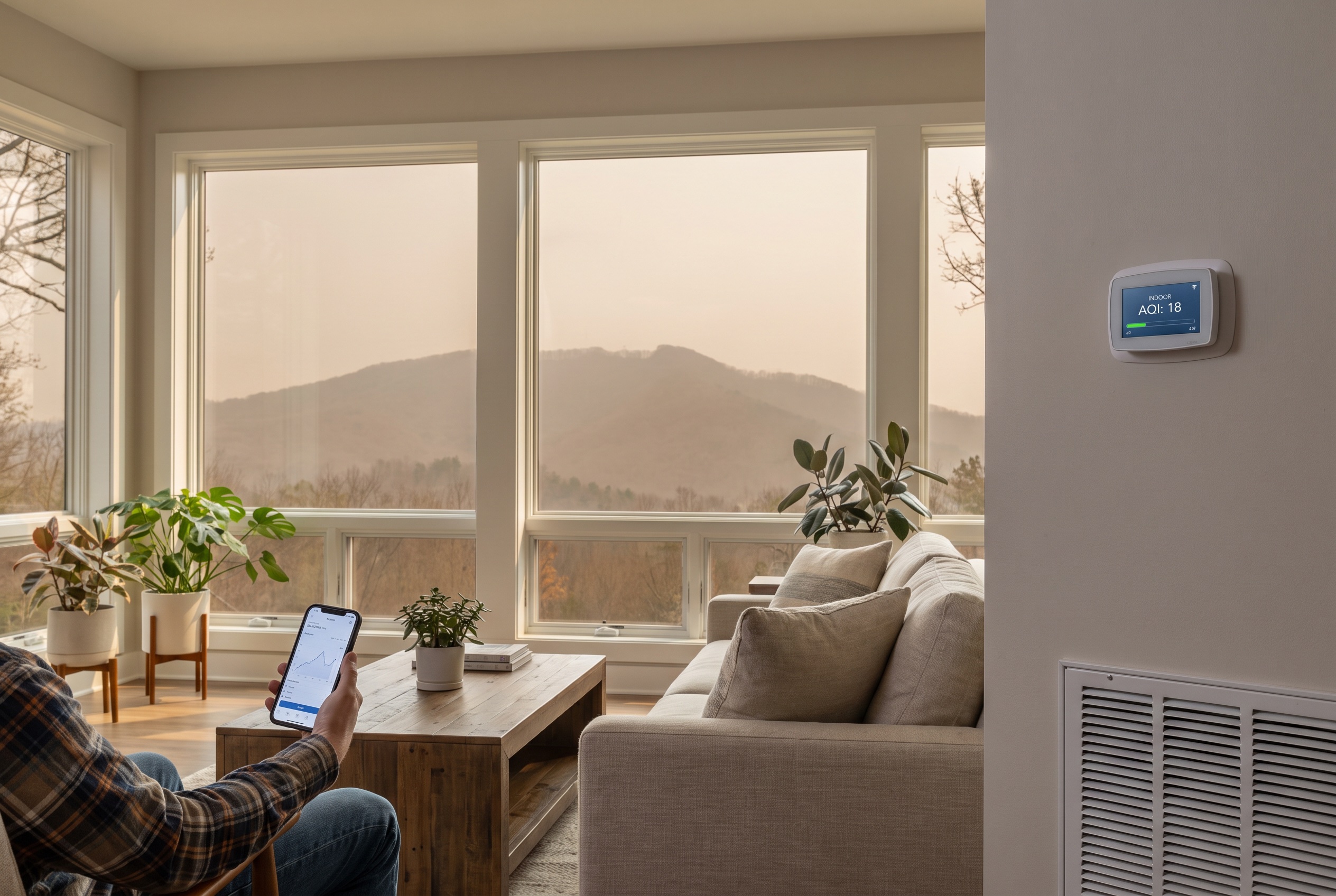
Wildfire smoke does not have to originate nearby to affect the air around your home. Smoke from wildfires—like the current ones in Canada—can travel hundreds of miles, creating hazy skies and elevated particle pollution across North Carolina and other parts of the East Coast.
That does not necessarily mean the air inside your house is protected. Fine particles can enter through open doors and windows, gaps in the building, ventilation systems, and other pathways. Fortunately, your heating and cooling system may be able to help improve wildfire smoke indoor air quality when it is operated and maintained correctly.
During the current smoke event, conditions around Raleigh have generally been less severe than in some areas farther north, but air quality can change as smoke plumes and weather patterns shift. Homeowners can check current conditions using the AirNow Fire and Smoke Map before deciding how aggressively to limit outdoor air exposure.
How Wildfire Smoke Affects Indoor Air Quality
Wildfire smoke contains a mixture of gases and very small particles. One of the primary concerns is PM2.5, particulate matter measuring 2.5 micrometers across or smaller. These particles are tiny enough to remain suspended in the air and travel deep into buildings.
A closed house can reduce exposure, but it is not airtight. Smoke can enter when doors open, through leaks around windows, and through mechanical ventilation that brings outdoor air inside. Once particles are indoors, everyday activities and air movement can keep them circulating.
Your HVAC system can help capture some of those particles as indoor air passes through its filter. The results depend on the type and condition of the filter, how often the air circulates, and whether the system is bringing in additional outdoor air.
Set the HVAC System to Recirculate Indoor Air
If your HVAC system or thermostat has a setting that controls outdoor-air intake, switch it to recirculate during smoky conditions. Recirculation keeps more of the existing indoor air moving through the system instead of continuously drawing smoky outdoor air into the house.
Not every residential system has an obvious fresh-air control, and the correct setting can vary by equipment. Some homes also have dedicated ventilation systems that operate separately from the main thermostat. When the controls are unclear, an HVAC technician can identify whether your system has an outdoor-air intake and explain how it should be managed.
The U.S. Environmental Protection Agency recommends closing fresh-air intakes or using recirculation mode when possible during wildfire smoke events. It also recommends making sure the HVAC filter fits securely so air does not simply pass around it. EPA’s wildfire and indoor air quality guidance provides additional steps for reducing smoke exposure inside a home.
Use the Right HVAC Filter for Wildfire Smoke
Filter efficiency is important because basic filters are often designed primarily to protect HVAC equipment from larger dust and debris. They may not capture the smaller particles found in smoke as effectively as a higher-efficiency filter.
EPA guidance recommends considering a filter rated MERV 13 or higher when the HVAC system can accommodate it. A higher MERV rating generally indicates that the filter can capture smaller particles more effectively. During smoky conditions, this can make the HVAC system more useful as a whole-house filtration tool.
However, the densest filter on the shelf is not automatically the right filter for every system. A filter that creates too much resistance can reduce airflow and place extra strain on the blower. Filter size, thickness, duct design, equipment specifications, and existing airflow all affect what the system can safely handle.
Bowman Heating, Cooling, & Plumbing can assess filtration and other healthy air options without treating every home as though it has the same equipment or indoor air quality needs.
Run the HVAC Fan More Often
A filter only captures particles while air is passing through it. During a smoke event, setting the thermostat fan from “Auto” to “On” can increase air circulation through the filter and help remove more suspended particles from the indoor air.
EPA guidance recommends operating the fan as often as possible when using a high-efficiency HVAC filter to create cleaner indoor air. This strategy works best when the filter is compatible with the equipment and the system has adequate airflow.
Running the fan continuously also means the filter may collect debris more quickly. Check it regularly rather than assuming the normal replacement schedule still applies. A filter that has become heavily loaded with smoke and dust can restrict airflow and lose effectiveness.
Check and Replace the Filter More Frequently
Wildfire smoke can place an unusual load on HVAC filters. Even a relatively new filter may become dirty faster than it would under ordinary summer conditions.
Inspect the filter during and after a prolonged smoke event. Replace it when it becomes visibly dirty or according to the equipment and filter manufacturer’s instructions. Make sure the replacement is installed in the correct direction and fits snugly in the slot.
Regular filter checks are also part of sound seasonal HVAC care. Bowman’s guide to AC maintenance for Raleigh homes explains how airflow, filtration, and routine service affect cooling performance during the summer.
Keep Windows, Doors, and Exhaust Fans in Mind
Keeping windows and exterior doors closed is one of the simplest ways to limit smoke entry. This is especially important when the outdoor air smells smoky, visibility is reduced, or local PM2.5 readings are elevated.
Kitchen exhaust fans, bathroom fans, clothes dryers, and other equipment can create pressure differences that encourage outdoor air to enter through small leaks. You still need to use ventilation when cooking or controlling moisture, but avoiding unnecessary or prolonged exhaust-fan operation may help reduce infiltration during the worst smoke periods.
Central air conditioning can keep the home comfortable while the windows remain closed. Before asking the system to run for extended periods, make sure the filter is clean and the equipment is working properly. Bowman’s preventative maintenance services can help identify airflow and performance problems before they become mid-summer breakdowns.
Consider a Portable Air Cleaner for Key Rooms
Central HVAC filtration can serve much of the house, but a portable air cleaner can provide additional filtration in a bedroom, living area, or designated cleaner-air room. Look for a unit with a true HEPA filter that is appropriately sized for the room where it will operate.
Place the cleaner where airflow is not blocked by furniture or curtains, and run it continuously when smoke levels are elevated. Avoid air-cleaning devices that intentionally generate ozone, since ozone is itself a lung irritant.
A portable unit does not replace proper HVAC filtration or stop smoke from entering the building, but it can add another layer of particle removal in the spaces where household members spend the most time.
Do Air Purifiers, UV Lights, and Other IAQ Products Remove Smoke?
Indoor air quality products solve different problems, so it helps to distinguish between them. Particle filtration is the main tool for reducing the fine particles associated with wildfire smoke. Higher-efficiency HVAC filters and portable HEPA air cleaners are designed for that job.
UV lights are generally used to address biological growth on HVAC components rather than airborne smoke particles. Humidity-control equipment can improve comfort and help manage moisture, but it does not function as a smoke filter. Some whole-home air-cleaning systems combine multiple technologies, though their effectiveness depends on design, installation, airflow, and maintenance.
The right solution begins with understanding what is in the air and how the existing HVAC system operates. Loading a system with add-ons that do not address the actual problem is an expensive way to decorate the ductwork.
Know When Outdoor Conditions Have Improved
Smoke conditions can change from one hour to the next. A hazy sky does not always correspond perfectly with ground-level particle concentrations, and clearer-looking skies do not guarantee that the air has returned to normal.
Use the Air Quality Index and local PM2.5 readings rather than visibility alone. AirNow reports current air-quality information and explains what the different AQI categories mean for the general public and people who may be more sensitive to pollution.
Once outdoor conditions improve, homeowners can return ventilation and thermostat settings to their normal configuration. Continue checking the HVAC filter for a few days, since particles collected during the event may have shortened its useful life.
Improve Indoor Air Quality Before the Next Smoke Event
Wildfire smoke may be an occasional problem in Raleigh rather than a daily one, but it highlights the importance of filtration, airflow, and a properly maintained HVAC system. The same improvements that help during smoke events can also reduce ordinary dust, pollen, and other airborne particles throughout the year.
Bowman Heating, Cooling, & Plumbing can evaluate your current filtration setup, confirm what filter efficiency the equipment can support, and recommend indoor air quality improvements suited to your home. To discuss your system or schedule an assessment, contact the Bowman team.
Frequently Asked Questions
Can wildfire smoke get inside a closed house?
Yes. Smoke particles can enter through doors, windows, building leaks, ventilation systems, and other openings even when the house is closed.
What HVAC filter is best for wildfire smoke?
EPA recommends considering a MERV 13 or higher filter when the HVAC system can safely accommodate it. An HVAC professional can help determine the appropriate efficiency and filter design for your equipment.
Should I leave my HVAC fan on during wildfire smoke?
Running the fan more frequently can move more indoor air through the filter. This may improve particle removal, provided the system has a compatible, clean filter and adequate airflow.
Should I turn off my air conditioner when it is smoky outside?
Usually, you can continue using central air conditioning while keeping windows and doors closed. Use recirculation mode and close outdoor-air intakes when possible so the system is not deliberately drawing smoky air indoors.
Will a UV light remove wildfire smoke?
UV lights are not designed to capture smoke particles. Effective particle filtration, such as a compatible high-efficiency HVAC filter or portable HEPA cleaner, is more relevant during wildfire smoke events.
Categories

Let's Talk.
We’ll be happy to get you the pricing, service or information you need as soon as possible.